Do White Boys Even Like Us?
The prerequisite yearning with Interracial Relationships among Black South African women—A conversation about low Racial Self-Esteem.

I had been off of social media and most crucially, TikTok, for some time, due to exams and other happenings in my life. When I returned to the app, one of the first videos to appear on my For You Page featured a South African Woman under the caption “What does a white boy who likes black girls look like? 🇿🇦🇿🇦 (ps I’m a visual learner)”.
This video was part of a larger trend, where individuals would typically post themselves with similar captions posed towards a person, or demographic of people they intended to attract. Said individuals would then reply to the video with pictures of themselves in the comment sections, indicating feelings of reciprocity and attraction.
This was not the case in regards to this video in question.
The comment section was bleak and empty, at least as it pertained to the group of men the message was directed toward. Notwithstanding the odd one or two genuine replies, the comment section consisted mainly of other South African women mocking the lack in turnout, expressions of exasperation aimed at highlighting how a trend like this only works in more developed countries, like the USA, Britain and European Countries, and comments that were satirical.
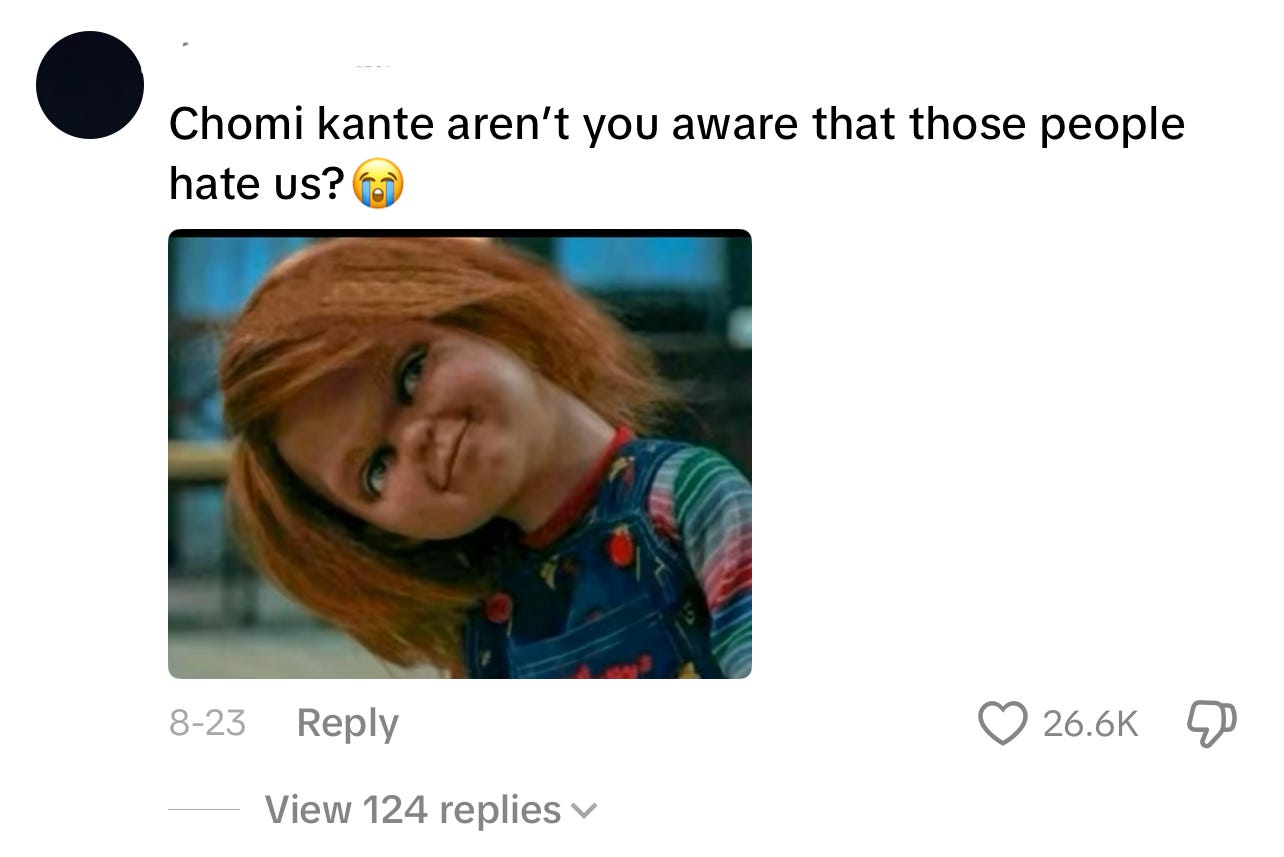
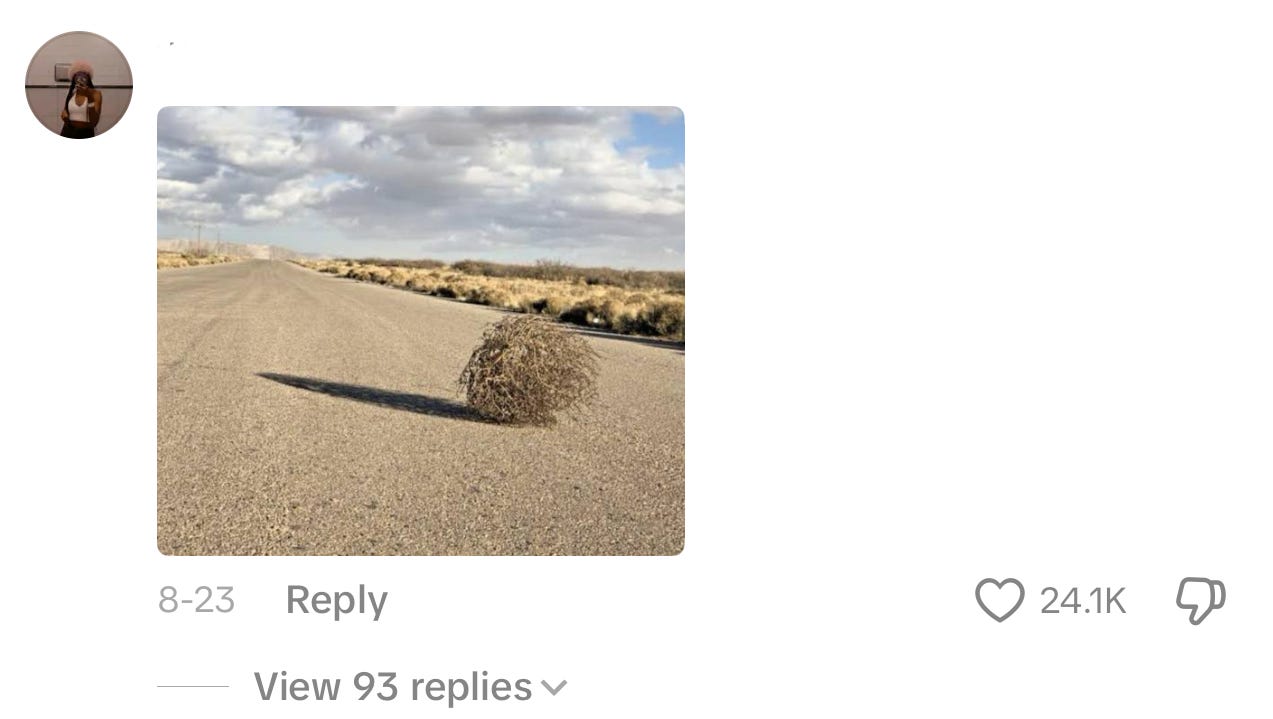
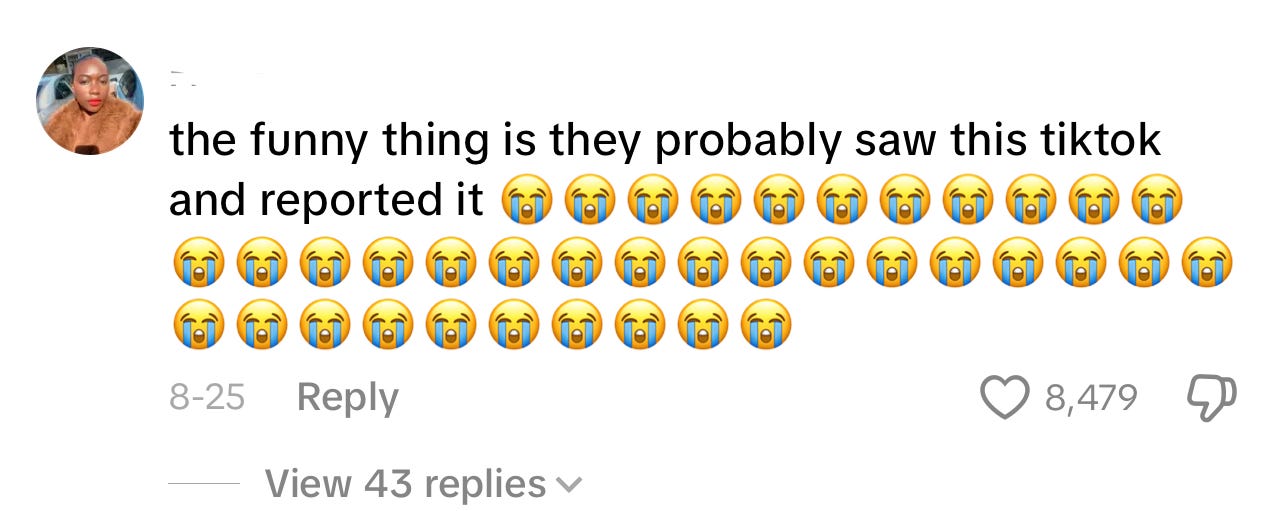
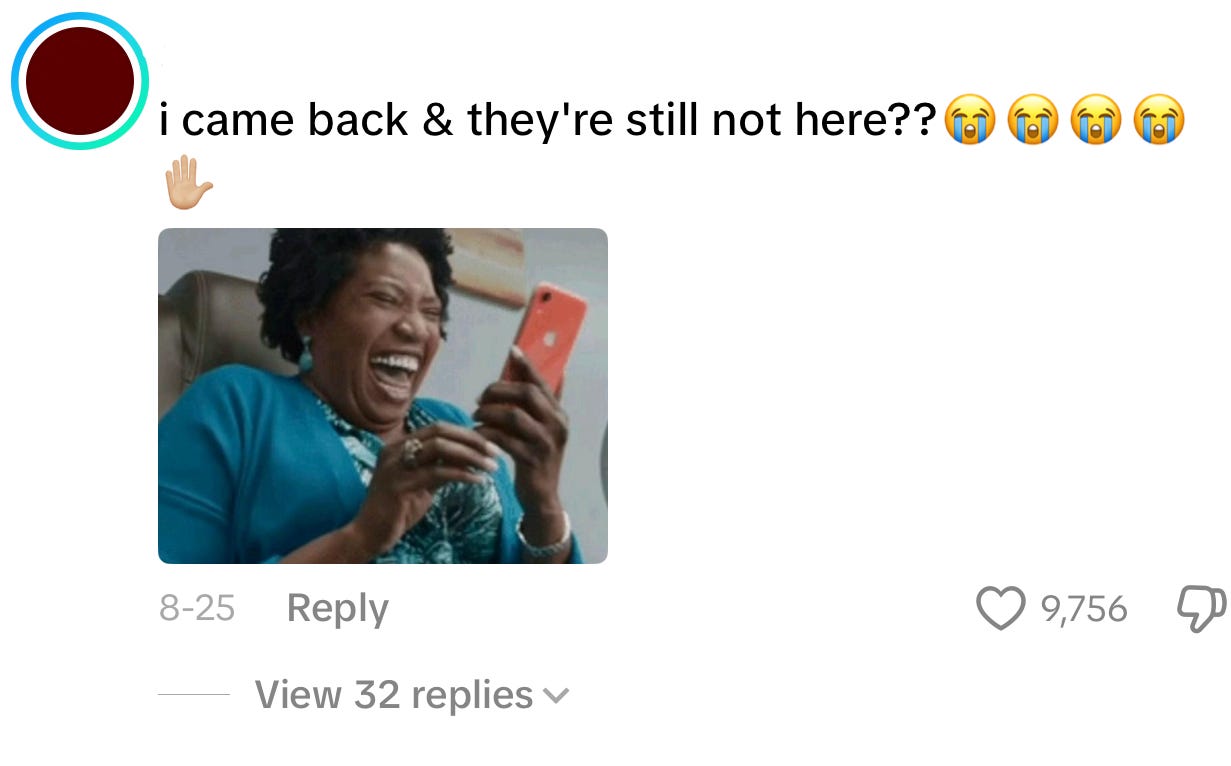
South Africa has an inescapable culture of making light of our internal political and cultural affairs, whether it be dismissing them in their entirety, reducing these events into tabloid-gossip or just finding them funny.
However, there is a very real and deeply unfunny political undertone to this video— to this trend as a whole in the context of South Africa. Given our Apartheid history (and reality), this video is attestation to a neglected wound in out country, as well as the way in which it manifests among black women.
In this essay, I will be attempting to unload this incredibly nuanced topic. I will be kickstarting an honest conversation essential to the understanding of how historical violence, systemic racism, and internalized oppression converge within the romantic lives of Black South African women. How these factors affect our romantic desires and a broader conversation about the emotional cost of desire under inequality. But first, on set-up, we need to discuss what this essay is not.
This essay is not an attempt to shift responsibility for violence in the form of racism onto black women. This has never and will never be the case. This is an exploration of how Black women are often forced into positions of idolizing whiteness, society’s universal deity of aspiration, and how this dynamic tends to manifest in the way we perceive interracial relationships in South Africa, particularly where a white man is involved.
This essay is not, in any context, an attack on individual and interracial love. It is of utmost importance to avoid essentialism, not every interracial relationship reflects the topics discussed in this essay, in fact, most are built on a mutual understanding of identity, political solidarity and shared appreciation of the greater societal structures that present themselves in our daily life. What is subject to my scrutiny is not this, but rather the historical contexts and contemporary cultural divides that uphold systems that force Black women into a perpetual pattern of yearning.
And, most crucially, this essay is not and will never be an attack on Black women. There will never be a time in which I participate in a conversation of this nature, without the interests of the most vulnerable yet most magical individuals in our society. Bear this in mind at all times when reading this essay.
Any discussion about interracial desire in South Africa cannot occur without the contextualisation of South Africa’s pre-democratic racial order. During Apartheid, the state did not just police where individuals lived and worked. It legislated who could love whom. Interracial relationships were strictly prohibited, condemned and outlawed.
“The National Party is determined to preserve the purity of the white race and to prevent the mixing of the races.”
Dr. Daniel François Malan (National Party Prime Minister, 1948–1954)
The Prohibition Of Marriage Act (1949) banned marriages between “whites” and “non-whites.” Even before this, The Immorality Act (1927, amended in
1950) similarly outlawed extra-marital sexual intercourse between white people and black people, which was later extended to all non-white people.
These laws were more than just legislation, they espoused a deeply moral statement sent out to the masses. That interracial relationships were abominable, unthinkable. That they were immoral. To white men, women of colour were perceived as undesirable and to women of colour, the same was very much true. In contemporary society, we see how this narrative has changed for women of colour, and more specifically, black women, being the group most likely to date outside of their race. Evidently, nothing much has changed for the average white man.
“There is no place for [the black man] in the European community above the level of certain forms of labour.”
Dr. Hendrik Verwoerd (National Party Prime Minister, 1958–1966)
In South Africa, race is still prominent presence in our society, with democracy being relatively callow in our country. With that, all the pre-democratic narratives about interracial dating still exist—hence the TikTok video, and other TikTok videos about black girls sharing their experiences being humiliated, rejected and conditionally accepted by their white counterparts on the basis of race. It’s why the question ‘do you like black girls?’ has often left the lips of many black women and girls open to interracial dating. The commonly held belief is that white men are not attracted to black women, this notion did not merely sprout from nowhere.
The other side of Apartheid’s sexual politics coin is fetishisation. As it turns out, laws did not extinguish desire. As a consequence of criminalising interracial relationships between “whites” and “non-whites,” the cultural implication was a taboo, forbidden aura surrounding interracial relationships. Desire that was illegal, in tandem with the already sexualised stereotypes surrounding black women, was only amplified and hyper-sexualised.
White men often fetishised black bodies as exotic and hyper-sexual, drawing on colonial tropes that characterised African women as animalistic, primitive or otherwise ‘closer to nature.’ For Black South African women, it meant being desired only for the taboo or forbidden appeal. It meant that Black women were desired only as objects for conquest, for exoticism, for gratification or as ‘forbidden fruit.’
These narratives and ideals are very much present in our society today. Black women and girls continue to face hypersexualisation and are subject to fetishisation. The subsequent power-imbalance in these dynamics, which makes itself known until this very day, exacerbated the aforementioned narratives and taboos surrounding interracial relationships and black women in general, 31 years after Apartheid ended.
There are numerous contemporary examples echoing this concept. The “white boy who likes Black girls” trend shows how fetishisation shapes interracial dynamics. The subtext of these kinds of videos isn’t “I’m a guy who sees Black women as my equal.” It’s “I’m a guy who likes Black girls.” which reinforces the idea of race as the primary axis of attraction.
With the empty comment section in the video mentioned earlier, in contrast to the often eager and active participation in the global north, illustrates a dual-dynamic. Fetishisation in the global north is glamorised and romanticised, and the same is true for South Africa, except it is distorted and complicated by our apartheid afterlives.
Black women in South Africa feel invisible, rejected, exoticised and notwithstanding, desired. Living in a country where you are perceived as unattractive, whilst being exposed to interracial relationships in other regions that clash against this notion creates cognitive dissonance and confusion. Then there’s fetishisation, and being desired only as a fetish has substantial damage on the perception of self. This, working in tandem with racism and white superiority, has lead to Black women, as well as other demographics in South Africa viewing them as subpar, inferior and undesirable.
The positioning of whiteness as the arbiter of aspiration by history, media, literature and social conditioning has only exacerbated the conditions black women who date outside of their race find themselves in. The outlawing and prohibition of interracial relationships during Apartheid was not just about creating racist narratives and an aversion to interracial relationships, but was also about maintaining racial “purity.”
It was about cementing whiteness as unattainable, untouchable, and ultimately superior. In the aftermath of apartheid, while the legal barriers have fallen, the symbolic hierarchy remains. Whiteness is still marketed as beautiful, sophisticated, and desirable, while blackness is too often caricatured, devalued, and fetishized.
Another consequence of this characterisation of whiteness is the glorification. White people have always been depicted as the epitome of romance. “White love” in cinema, poetry, literature and music has always been the norm. The depiction of yearning, longing, affection and love has always been done through the lens of the white man and woman, and when it isn’t—it’s always niche, subversive and rare. It isn’t that the white man is inherently gentler or more loving, but that history has coded him as such.
Whiteness is positioned as the language of love. This, the tip of the iceberg of desirability politics will have its own dedicated essay, but the point I want to make is that whiteness has always been depicted as the epitome of anything for centuries, and although nowadays a steadfast effort has been made to deconstruct this system, we still have a long way to go.
In South Africa, Black Women continually face challenges and shoulder great burdens often at the hands of black men. Our abusers, our politicians, our leaders, our lovers. Black women are continually failed by black men in their lives, rejected and abused. This creates a pattern, cyclical and devastating in nature. Those entrusted with our protection are too often the source of our harm. What manifests from this is not a simple narrative of interpersonal betrayal, but a collective wound. A rupture in the relational fabric between Black women and Black men.
These factors working together create a landscape where trust has eroded and care feels scarce, and it is unsurprising that some Black women may look outward for safety, tenderness, or affirmation. And who better to represent that imagined sanctuary than the figure whom history itself has positioned as a saviour—the white man?

Thus, black women continue to desire white men. The positioning of the white man as a saviour is not accidental. It is the end-product of centuries of narrative engineering. Colonialism and Apartheid worked tirelessly to script whiteness as synonymous with virtue, intellect, gentleness, and control. These traits were not merely admired, they were weaponised as contrast to the alleged volatility and danger of Black masculinity.
For Black women, raised in a society where safety and tenderness are scarce, where they ought to fight to be seen, heard and respected, this construction seeps into the subconscious, shaping what love is imagined to look like. Desire becomes political and mirrors the power dynamics we were born into.
To crave the white man is, in many ways, to crave reprieve from the chaos and pain inflicted by patriarchy, anti-blackness, racism, misogynoir, interpersonal violence, GBV, homophobia and other forms of violent oppression within and beyond our communities. It is to seek a ‘gentle love.’ But when that desire is rooted in escape rather than mutual recognition, it risks reproducing the same hierarchies it seeks to transcend. What appears as attraction may, in truth, be the haunting echo of survival.
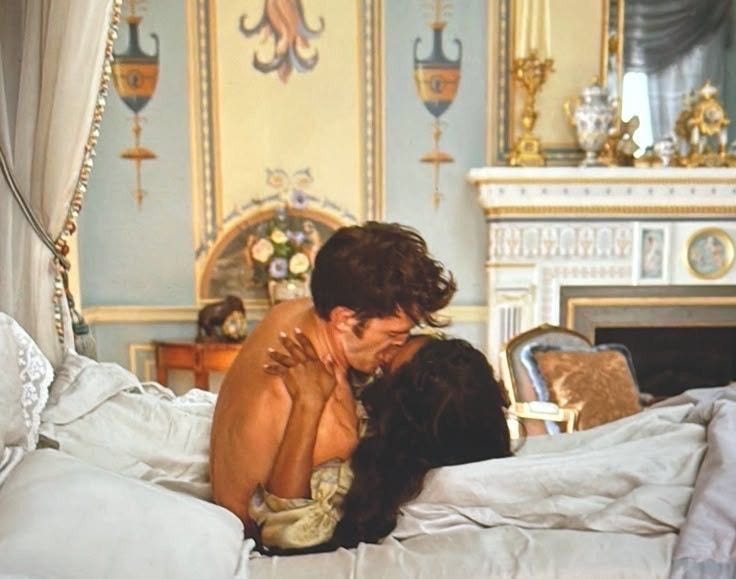
Low racial self-esteem is a term I utilise in this essay to describe the internalized belief that one’s Blackness diminishes their worth in the romantic marketplace. Low racial self-esteem knows the heart of a black woman very well. As a black woman, in accordance to the spectrum of whiteness, I am at the very bottom of the barrel on the hierarchy of desirability.
Whiteness is measured according to the yardstick that is my undesirability. It is expected then, to feel insecure about my race. About my existence as a whole. Have you, or any other Black women you know, ever questioned whether your race affected how you were treated romantically? The answer is likely yes.
Desire in a racist world is a mirror with a crack running through it, every reflection is distorted.
unknown
The truth is, South Africa has a weird relationship with interracial dating. Among the youth, at best, there is a gradual inclination towards interracial relationships. At the very worst, there is a gradual tolerance towards them. Our country is healing, not healed. The work is far from over. Understanding the complex power-imbalances, contexts and conditioning that these interracial relationships exist in is vital towards understanding interracial relationships as a whole.
There are very real risks associated with interracial relationships—especially in South Africa. There are countless horror stories about Black women finding out that their partners were racist or had merely fetishised them throughout their relationships. This is often why Black women don’t try, why Black women are forced into apprehension when considering dating out of their race.
Understanding interracial desire among Black South African women requires more than surface-level explanations. It demands we trace the lineage of our longing back through centuries of legal prohibitions, social hierarchies, and psychological conditioning. To ask uncomfortable questions like “Why do I desire this specific type of person so vehemently?””What has fuelled my attraction towards this particular person?” “What is the psychosocial aspect and historical context behind my attraction towards this individual?”
Everything exists in the context of something else.
The yearning for whiteness, for safety, for affirmation in someone positioned as a “saviour,” is not a betrayal of ourselves or our communities—it is the echo of a system that meticulously taught us to question our worth. Desire, in this context, is never neutral. It carries the weight of history, the very prominent imprint of apartheid, and the persistent whisper of a society that still ranks bodies, skin tones, and gendered expressions of love.
Awareness will always be the first step toward reclamation. To interrogate why we desire whom we desire, to question the sources of that longing, is to carve a space of autonomy in a world that has far too often dictated our hearts. Low racial self-esteem does not have to be permanent; it can be named, understood, and deconstructed. By recognizing the structures that shape our attraction, by seeing the politics of love for what it is—Black women can reclaim the power to define desire on their own terms.
Ultimately, this conversation is not about vilifying interracial relationships, nor is it about casting blame. It is about bringing forward the forces that continue to shape how Black South African women see themselves in love. It is about acknowledging the wounds, naming the patterns, and being brave enough to imagine a world where desire is freed from the shadow of history. But, we cannot move on from what we refuse to acknowledge.
Because until the day Black women no longer measure their beauty, worth, or desirability through the eyes of whiteness comes, the question will remain not,
“Do white boys like Black girls?”
but rather,
“Why must our desirability be seen through anyone else’s gaze at all?”
Your essay made me realise something so interesting. Being someone’s who’s always loved novels…the demographics in novels that had love stories were often just white love over and over again. There were barely any books that were well written and placed black love or black women’s experiences at the centre. Deliberately so..our lives as black people most often than not cannot be told without some level of suffering and it is frustrating that black love or blackness as a main character in any novel or piece of literature must always include some suffering. Black women are not afforded the neutrality that comes with whiteness..or rather we aren’t the ‘default’. We cannot experience outside of the bounds set by white supermacy. And this is a reality for black women, not just fiction. It is no wonder then black women aspire towards whiteness because as you said whiteness is afforded the capacity to be gentle..to be multifaceted and individual. But I also understand that black women’s desire for white men at times (well most of the time) is by design. White supremacy’s job was to erode the black family structure and initially it failed by trying to appeal to black women (who are typically racially loyal) but recently it has succeeded more so as black men move from victims to perpetrators of oppression themselves, as you said..a rupture of sorts. I wouldn’t even say South Africa is healing necessarily, it’s just in a different phase of white supremacy and capitalism, but that’s a different conversation. Tying it back to the epiphany I came to earlier this year when I questioned why I was even willing to date white men when asked by a friend..I explained that I would rather date a white man than a black man because living in a country like South Africa, and in general our world, there is a great likelihood I may fall victim to being murdered by a man. I would rather that man be a white man than it be someone who looks like my fathers, my uncles, my brothers..I told her my soul would not be able to handle that level of anguish. But with a white man..I’ll always expect it. Interesting essay and conversation!
This is such a profound and necessary conversation. Your analysis of how apartheid's legacy lives on through the internalized devaluation of Black bodies, especially Black women's bodies, cuts to the heart of something so many of us carry but struggle to name. The connection you draw between colonial structures and contemporary desire patterns is essential - you're right that this goes far beyond individual 'preferences' to deeply embedded psychological colonization.
What strikes me most is your honesty about the 'white gaze' operating even within our own communities, and how that feeds into both fetishization from outside and self-rejection from within. This dual trauma - being both exoticized and devalued - is exhausting in ways that deserve more attention. Thank you for your courage in writing this, especially knowing how vulnerable these truths make you. Stories like these are how we begin the long work of decolonizing our own hearts and minds.